
Honeywell Air Duct Cleaning in Cypress: A Homeowner’s Guide
If your Cypress home runs a Honeywell smart thermostat or zoning system, the duct network behind it is likely more segmented than a standard single-zone setup – which means a cleaning that doesn’t account for each zone’s damper positions is only cleaning part of your system. That’s the part most homeowners never hear about, and it’s the part that matters most. If you’d rather not sort through damper positions and filter media on your own, call (844) 625-7168 and we’ll walk you through it.
Honeywell equipment changes how a duct cleaning should be scoped and sequenced. A system with a Honeywell electronic air cleaner, a media cabinet, a humidifier tied into the return, and a zoning panel controlling several motorized dampers isn’t the same job as a plain single-zone house. Treating it that way is how components get damaged and the dirtiest branches get skipped entirely.
Key Takeaways
- Honeywell zoning systems divide your ductwork into separate branches – each one needs to be reached and cleaned on its own.
- Electronic air cleaners and media filters come out before cleaning begins, then get serviced and put back.
- Honeywell humidifiers create moisture patterns in the ductwork that are worth checking for before you clean.
- Your smart thermostat’s runtime history is real diagnostic data. Ask for it before anyone opens a register.
- After cleaning, filter timers need resetting and zone dampers need re-commissioning so airflow stays balanced.
Why Honeywell Zoning Changes How Your Ducts Get Cleaned
A zoned Honeywell system works by splitting the ductwork into branches, each controlled by a motorized damper. The thermostat calls for heat or cooling in one zone, that zone’s damper opens, and the others close. It’s an efficient way to run a house with rooms that heat and cool unevenly – and it’s common in Cypress homes where an addition, a second story, or a converted space needs its own temperature control.
The cleaning problem is simple: a damper that’s closed blocks the branch behind it. Run negative pressure on the whole system at once and you pull mostly from the open zones while the closed branches sit there full of debris. The registers look clean, the homeowner feels satisfied, and the dirtiest section of ductwork never got touched.
What a technician should actually do:
- Map every zone and note which damper serves which branch.
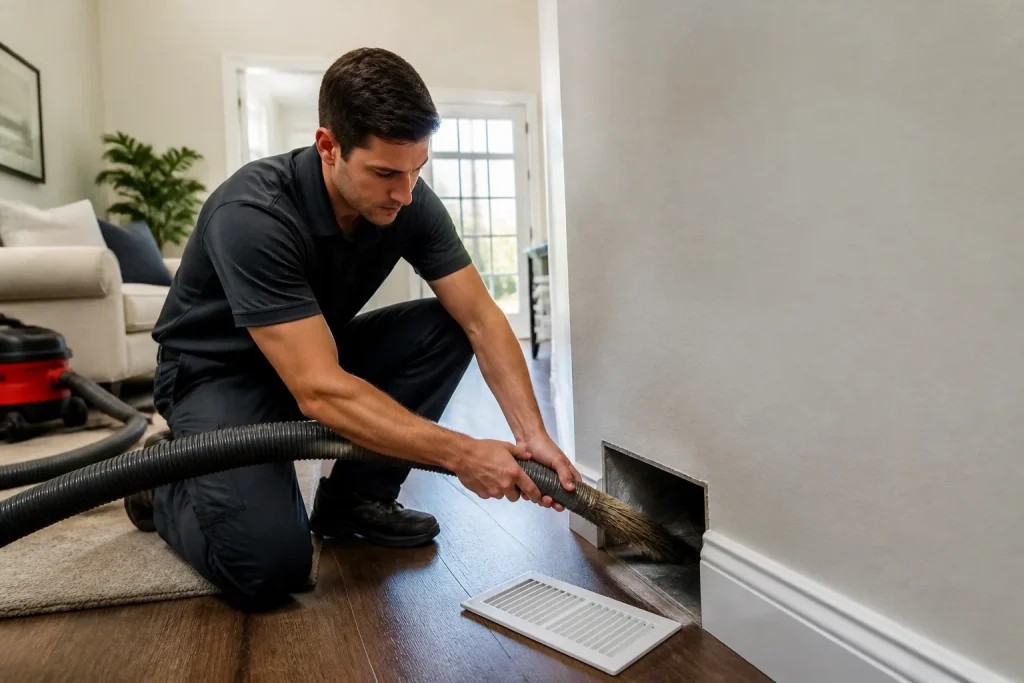
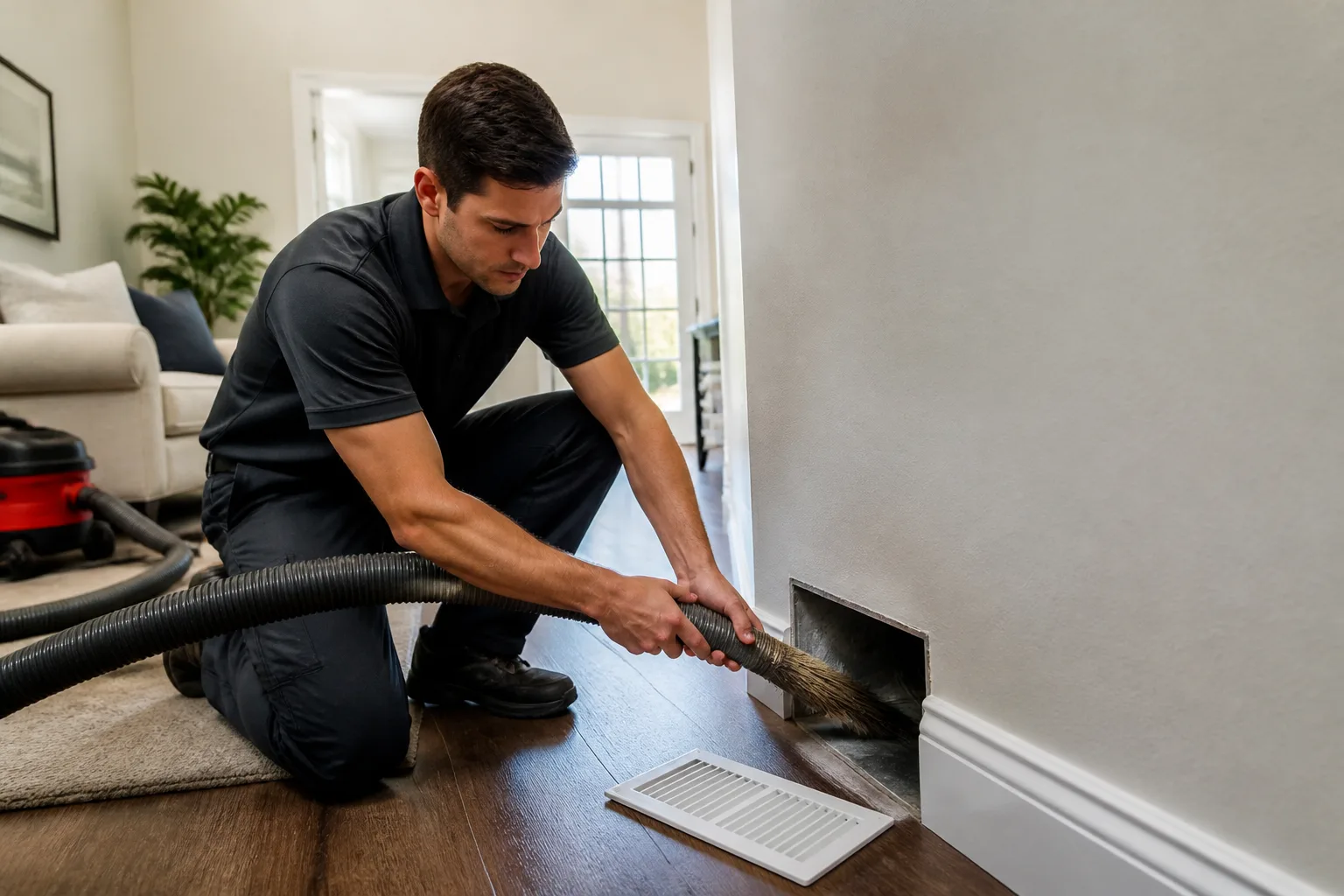
- Open each damper in turn (or manually override it) so the branch can be reached with negative pressure and the rotating brush.
- Clean that branch fully, then move to the next zone and repeat.
- Document each zone separately so you can see the whole system was covered, not just the easy half.
This is why we ask about zoning before we arrive in Cypress. A Rotobrush or Nikro system does the heavy work, but the sequencing is what determines whether every branch gets the treatment.
Electronic Air Cleaners and Media Filters: Pull Them First, Not Last
Honeywell electronic air cleaners and media filter cabinets sit in the return airstream, right where a duct cleaning’s negative pressure is headed. If nobody removes them first, two things happen. The filter media catches everything you’re trying to extract, and the EAC’s collector cells take a beating from brush contact and debris. Neither outcome is acceptable.
The correct order is:
- Remove the EAC cells or the media filter before any negative pressure starts. They are not obstacles to work around – they’re components to service.
- Clean the EAC cells as a separate step. Electronic cells collect charged particles and need proper washing, not a blast of air from a shop vac.
- Inspect the filter cabinet for bypass gaps. A cabinet that doesn’t seal tightly lets unfiltered air slip past the media, which is a common reason a system still runs dirty after a cleaning.
- Reinstall the cells or a fresh media filter only after the ductwork and the air handler are clean.
If you’re upgrading filtration after a cleaning, Honeywell and Aprilaire media cabinets are the two we work with most – they’re built to be serviced rather than replaced whole, which matters over the life of the system.
Honeywell Humidifiers and the Moisture Patterns They Leave Behind
A whole-house humidifier tied into a Honeywell system introduces moisture into the airstream by design. That’s fine when everything is working correctly and the humidifier is maintained. When it isn’t, the ductwork is where you’ll find the evidence first.
What’s worth checking in a Cypress home with an integrated humidifier:
- Mineral scale and white dust near the humidifier’s duct connection. Hard water leaves deposits that can flake into the airstream.
- Damp patches or staining on duct liner downstream of the humidifier. Moisture that doesn’t fully evaporate becomes a surface for biological growth.
- Musty odor when the system first kicks on. If it fades after a few minutes, the source is often in the ductwork, not the room.
- A humidistat set too high. Over-humidifying is a common and easy fix – the target is comfort, not fog.
None of this means you should skip the humidifier. It means the humidifier’s interaction with the ductwork deserves a look before the cleaning starts, so any moisture issue gets addressed rather than scrubbed over. Our air duct cleaning service covers that inspection as part of the scope, and if we find compromised duct liner or a leak, our HVAC cleaning and repair work can handle it in the same visit.
Your Smart Thermostat Is Already Telling You Something Useful
Before a technician opens a single register, your Honeywell thermostat has already collected the diagnostic history. Runtime hours, filter change alerts, and zone-by-zone demand patterns are exactly the kind of information that tells a technician where to look first.
What to pull up and share:
- Equipment runtime hours – if your blower has been running far longer than usual for the season, restricted airflow is one likely cause.
- Filter change alerts – how frequently they’ve triggered tells you how fast the system is loading up.
- Zone demand history – a zone that calls constantly while another rarely does suggests a damper stuck open or closed, or a branch with a restriction.
- Any error codes logged in the system – a static pressure fault or airflow alert is worth flagging before cleaning.
In our experience, homeowners who bring this information to the estimate get a more precise scope and a better result. It takes two minutes in the thermostat menu, and it turns a generic “clean the ducts” job into a targeted one. Professional-grade equipment paired with real data beats a guess every time.
What Happens After the Cleaning on a Honeywell System
Finishing a Honeywell system properly takes a few extra steps. Skip them and you’ve cleaned the ducts but left the controls out of sync with the work – which shows up as uneven temperatures, short cycling, or a filter alert that fires far too early.
The post-cleaning checklist should include:
- Reset the filter timer. Your thermostat tracks filter life by runtime hours, and it doesn’t know you just installed a fresh media filter. Reset it or the alert will fire early.
- Re-commission the zone dampers. Cycle each damper open and closed to confirm it responds correctly and returns to its commanded position. A damper that was manually overridden for cleaning needs to be handed back to the zoning panel.
- Verify airflow balance across zones. Check that each zone heats and cools the way it did before, and if it doesn’t, the damper or a branch restriction is the place to look.
- Confirm the EAC cells are seated correctly if your system has them, and that the filter cabinet is sealed.
One light note: if your thermostat has ever shown a “filter” alert the day after you changed the filter, you’re not imagining it. It’s just doing its job with old math. A reset fixes it.
When to Call a Pro
Some duct cleaning tasks are genuinely better left alone. Zoned systems with motorized dampers, electronic air cleaners with charged cells, and humidifiers tied into the ductwork all have components that can be damaged by the wrong approach or the wrong equipment. A consumer-grade vacuum and a brush on a drill won’t reach a closed branch, won’t remove an EAC cell safely, and won’t re-commission a damper afterward.
You should call a pro if you notice:
- Uneven temperatures between zones that weren’t there before
- Visible dust or debris blowing from registers when the system starts
- Musty or stale odors on startup
- A filter alert that keeps triggering within days of replacement
- Any sign of moisture, staining, or scale near a humidifier connection
We use Rotobrush and Nikro systems on every job, and Abatement Technologies air-scrubbing equipment for the sanitizing pass. Our technicians have up to 13 years of experience with systems like these. When we find a problem – a leaking duct, a stuck damper, a bypass gap – we can fix and seal it in the same visit through our Duct Repair & Sealing service, so you’re not calling a second contractor afterward.
Related services in Cypress: if your system is running well but the lint trap never seems to fill, our dryer vent cleaning keeps that airflow path clear too. For the full picture of what we do, start at Cypress Air Duct Cleaning Co.
The Bottom Line
A Honeywell-equipped home in Cypress has a more segmented duct system than most, and cleaning it correctly means mapping zones, sequencing each branch, pulling filter media and EAC cells before the vacuum starts, and re-commissioning the controls afterward. Done that way, you get a whole system that’s actually clean, not just registers that look clean. Done the shortcut way, you get a dust-free surface and a hidden branch that keeps feeding the problem.
If you’re in Cypress and need help, Cypress Air Duct Cleaning Co offers free estimates – call (844) 625-7168. We answer 24/7. Fast dispatch from 7am to 7pm, Sunday through Friday.
Frequently Asked Questions
Yes. Each zone is a separate duct branch behind a motorized damper, and a closed damper blocks cleaning access. Every branch has to be opened and cleaned on its own, in sequence, or part of your system stays dirty.
They should be removed and serviced separately before any negative pressure begins. The collector cells need proper washing, and reinstalling them comes only after the ductwork and air handler are clean.
The filter timer should be reset, each zone damper re-commissioned through the zoning panel, and airflow verified across all zones. A thorough technician will walk you through each step at the end of the job.
Sometimes not. If your Honeywell filter alerts rarely trigger and airflow is even across zones, your system may not need cleaning yet. Bring your thermostat’s runtime history to the estimate and we’ll tell you honestly whether it’s time. Call (844) 625-7168 for a free estimate.
Written by the team at Cypress Air Duct Cleaning Co.
Need Air Duct Cleaning Help?
Call Cypress Air Duct Cleaning Co - the local pro we connect you with is licensed and insured, with free written estimates in Cypress.
(844) 625-7168